Effectiveness of Saturated Salt Solution to Embalm Cadavers in Comparison to Thiel Solution and Formalin Solution for Surgical Skill Training
Ashwini N.S · Int J Anat Res 2026;14(3):9670–9679
1 Professor and Head, Department of Anatomy, Sri Devaraj Urs Medical College, Sri Devaraj Urs Academy of Higher Education and Research, Kolar, Karnataka, India.
Corresponding Author: Dr. Ashwini N.S, Professor and Head, Department of Anatomy, Sri Devaraj Urs Medical College, SDUAHER, Kolar, Karnataka, India. · drashwini2000@gmail.com
Abstract
Background
Human cadavers are invaluable resources for anatomical education and surgical skill training. Cadaver-based simulation allows surgeons to practice operative techniques in a controlled environment without risk to patients. The quality of surgical training depends greatly on the preservation method used, as embalming influences tissue consistency, flexibility, colour, joint mobility and similarity to living tissues. Formalin embalming remains the most widely used preservation technique because of its excellent fixation, antimicrobial activity and long-term preservation. However, formalin-fixed tissues become rigid, lose elasticity and demonstrate altered handling characteristics, limiting their usefulness for advanced surgical simulation. Alternative methods such as Thiel embalming and saturated salt solution (SSS) embalming have been developed to provide improved tissue realism. Although Thiel embalming provides excellent tissue quality, its complex preparation and higher cost restrict widespread application. Aim: To compare the effectiveness of saturated salt solution embalming with Thiel and formalin embalming methods for cadaver-based surgical skill training.
Methods
A pilot comparative observational study was conducted using 3 adult human cadavers obtained through the institutional body donation programme. Each cadaver was preserved using one of three embalming techniques: formalin solution (FS), saturated salt solution (SSS), and Thiel solution (TS). Cadaver suitability for surgical skill training was assessed by clinicians using a structured five-point rating scale. Parameters evaluated included tissue appearance, colour, texture, tactile sensation, surgical handling and overall usefulness for training procedures. Range of motion (ROM) of major joints was measured bilaterally using a standard goniometer.
Results
Formalin-preserved cadavers demonstrated increased tissue stiffness and reduced joint mobility compared with SSS- and Thiel-preserved cadavers. Clinicians rated SSS and Thiel-preserved cadavers as more similar to living tissues in terms of handling characteristics and usefulness for surgical training. The SSS method showed comparable performance to Thiel embalming in surgical skill assessment. The mean clinician suitability scores were 2.87, 4.57 and 4.83 for formalin, SSS and Thiel embalming respectively. Joint mobility measurements demonstrated better preservation of movements in SSS and Thiel groups compared with formalin preservation.
Conclusion
Saturated salt solution embalming provides a simple, economical and effective alternative to conventional formalin preservation for cadaver-based surgical skill training. It offers tissue handling characteristics comparable to Thiel embalming while requiring fewer resources, making it suitable for wider implementation in anatomy departments and surgical training centres.
Background:
Human cadaveric dissection has been an essential component of medical education since the development of modern anatomy [1,2]. Beyond undergraduate anatomical teaching, cadavers have become increasingly important models for postgraduate surgical training, procedural simulation and evaluation of emerging surgical techniques [3].Cadaver-based surgical training allows clinicians to practice complex procedures in a controlled environment without compromising patient safety [4-6].
The suitability of cadavers for surgical simulation largely depends on the preservation technique employed. The ideal embalming method should maintain anatomical structures, preserve tissue colour and consistency, prevent decomposition and microbial contamination, and provide realistic handling characteristics similar to living tissue [3,6-11].
Formalin-based embalming has been the standard preservation technique for more than a century due to its excellent fixation properties, antimicrobial activity and long-term preservation capability. However, formaldehyde cross-links tissue proteins, resulting in increased rigidity, loss of elasticity, altered tissue texture and reduced joint mobility. These changes limit its effectiveness for advanced surgical simulation. In addition, formaldehyde exposure is associated with occupational health concerns among healthcare workers and anatomy personnel [3,6-11].
Thiel’s embalming method, introduced by Walter Thiel, has gained popularity due to its ability to preserve natural colour, flexibility and tissue consistency. Thiel-embalmed cadavers have demonstrated usefulness in various surgical disciplines including minimally invasive surgery, orthopaedics, urology and vascular procedures. However, the technique requires multiple chemical components, prolonged preparation and specialized facilities, making it expensive and difficult to implement in resource-limited settings [4,5,8].
The saturated salt solution (SSS) embalming method has emerged as a promising alternative. It uses sodium chloride as a major preservative component along with additional antimicrobial and tissue-preserving agents. Previous studies have demonstrated that SSS-embalmed cadavers provide realistic tissue handling characteristics and are suitable for surgical skill training. The method is comparatively inexpensive, technically simpler and requires less complex preparation than Thiel embalming [1,2,6].
The selection of an appropriate embalming technique remains a challenge for anatomy departments and surgical training centres. A preservation method that combines realistic tissue properties, safety, affordability and feasibility would significantly improve access to cadaver-based surgical education [6,11].
Therefore, the present study was undertaken to compare saturated salt solution, Thiel’s method and conventional formalin embalming techniques with respect to surgical training suitability and joint mobility.
AIM: To evaluate the effectiveness of saturated salt solution embalming for cadaver-based surgical skill training in comparison with Thiel’s method and conventional formalin embalming.
OBJECTIVES
- To compare the suitability of cadavers embalmed by formalin solution, saturated salt solution and Thiel’s method for surgical skill training.
- To evaluate and compare the range of motion of joints in cadavers preserved using the three embalming techniques.
MATERIALS AND METHODS
Study Design and Study Setting:
The present study was an observational comparative study conducted in the Department of Anatomy, Sri Devaraj Urs Medical College, Sri Devaraj Urs Academy of Higher Education and Research, Kolar, Karnataka, India.
The study was designed to compare three different embalming techniques used for preservation of human cadavers for surgical skill training:
- Formalin solution (FS) embalming
- Saturated salt solution (SSS) embalming
- Thiel’s solution (TS) embalming
The study evaluated the suitability of each preservation method based on surgical handling characteristics and joint mobility.
Ethical Considerations: The study was conducted after obtaining approval from the Institutional Ethics Committee of Sri Devaraj Urs Academy of Higher Education and Research.
All cadavers included in the study were obtained through the approved body donation programme of the institution. The identity and personal details of the donors were kept confidential throughout the study. The study procedures were performed according to institutional guidelines for the respectful handling and use of human cadaveric material for education and research purposes.
Study Population: Three fresh adult human cadavers were included in the study.
Inclusion Criteria
- Fresh adult human cadavers received through the institutional body donation programme.
- Cadavers irrespective of sex.
- Cadavers suitable for embalming and anatomical preservation.
Exclusion Criteria
The following cadavers were excluded:
- Previously embalmed cadavers.
- Formalin-fixed cadavers.
- Decomposed bodies.
- Autopsied bodies.
- Cadavers with significant trauma or pathological alteration affecting assessment.
Embalming Procedures
Three different embalming techniques were used for preservation.
1. Formalin Solution Embalming (FS)
A standard formalin-based embalming procedure was performed.
A 3 cm incision was made in the posterior triangle of the neck. The common carotid artery was identified, cannulated and connected to a cadaver injection machine. The embalming solution was infused through the arterial system by gravity-assisted perfusion.
After completion of embalming, the cannula was removed and the artery was ligated. The cadavers were preserved using conventional formalin solution until evaluation.
2. Saturated Salt Solution Embalming (SSS)
Cadavers were embalmed using the saturated salt solution technique.
The solution contained saturated sodium chloride with additional preserving and antimicrobial components. Arterial perfusion was performed using the same vascular access technique described for formalin embalming.
The saturated salt solution method was selected because of its reported ability to maintain tissue flexibility, reduce microbial growth and provide realistic tissue handling characteristics.
3. Thiel’s Solution Embalming (TS)
Thiel embalming was performed using the immersion preservation method.
The Thiel embalming solution was prepared using sequential preparation of:
- Stem solution A
- Stem solution B
- Stem solution C
The stock solution was prepared by combining the stem solutions with propylene glycol and hot water. The final embalming solution contained:
- Sodium sulphite
- Morpholine
- Ethanol
- Low concentration formaldehyde
- Additional preserving components
After arterial embalming, cadavers were immersed in their respective preservation solutions for approximately 2–3 months before evaluation.
Assessment Parameters
The three embalming methods were compared using the following parameters:
1. Evaluation of Surgical Skill Training Suitability
The suitability of cadavers for surgical skill training was assessed by experienced clinicians from different specialties.
Specialties included:
- General surgery
- Plastic surgery
- Orthopaedics
- ENT
- Ophthalmology
- Anaesthesia
- Emergency medicine
- General medicine
- Obstetrics and gynaecology
A total of 10 clinicians participated in the evaluation.
To reduce observer bias, evaluators were blinded regarding the embalming method used for each cadaver.
Surgical Procedures Evaluated
The following procedures were performed:
- Skin incision and suturing
- Vessel identification and ligation
- Vascular repair procedures
- Exposure of major vessels
- Central venous catheterisation
- Tracheostomy simulation
- Chest tube insertion
- Lumbar puncture simulation
- Ultrasonography-guided procedures
- Pelvic and abdominal surgical approaches
Evaluation Scale: A structured five-point Likert rating scale was used.
Each evaluator compared cadaver tissue characteristics with living human tissue.
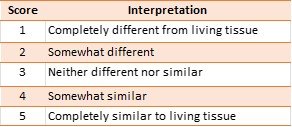
The following characteristics were evaluated:
- Visual appearance
- Tissue colour
- Tissue consistency
- Tactile sensation
- Surgical handling
- Overall usefulness for surgical training
2. Measurement of Joint Range of Motion (ROM)
Joint mobility was assessed in all three embalmed cadavers.
The following joints were evaluated:
- Shoulder joint
- Elbow joint
- Wrist joint
- Hip joint
- Knee joint
- Ankle joint
Measurements were obtained bilaterally using a standard goniometer recorded as degrees.
Movements assessed included:
Upper Limb
- Flexion
- Extension
- Abduction
- Medial rotation
- Lateral rotation
Lower Limb
- Flexion
- Extension
- Adduction
- Abduction
- Medial rotation
- Lateral rotation
- Plantar flexion
- Dorsiflexion
Table 1: Composition of Different Embalming Solutions.
Methodology/assessment:
Assessment is done by using structured questionnaire as follows:
1. To determine the surgical skill training in cadavers embalmed by 3 embalming methods
Blinding of the evaluator/surgeon about the cadavers embalmed by 3 different embalming methods is very essential before evaluation.
Visual and tactile assessment, skin incision and suture, vessel ligation and suture and usefulness for surgical skill training will be evaluated by 10 Clinicians-ENT, Ophthalmology, Plastic surgery, General surgery, Orthopaedics, Anaesthesia, Emergency medicine, General medicine, OBG using a 5-point rating scale in comparison to living subjects
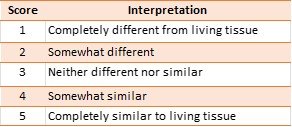
1. completely different
2. somewhat different
3. neither different or similar
4. somewhat similar
5. completely similar
5 point rating scale
The evaluator was supposed to perform a common basic procedure/technique on 3 cadavers embalmed by 3 embalming methods and rank them according to the criteria. Ex. exposure of femoral vessels or neck vessels, central venous catheterisation, tracheostomy, pelvic package, liver package, lumbar puncture, vascular repair, chest tube insertion, ultrasonography etc.
To measure the range of motion of joints of cadavers embalmed by 3 embalming methods
Range of motion of joints was measured on both right and left sides of each cadaver using standard goniometer.
Results
To determine the surgical skill training in cadavers embalmed by 3 embalming methods
In both visual and tactile assessments, the surgeons felt that the FS-embalmed cadaver was more significantly divergent from living patients than the TS or SSS embalmed. In addition, for each procedure, the FS-embalmed cadaver was evaluated to be significantly less suitable than the TS and SSS embalmed. The SSS-embalmed cadaver did not show statistically lesser values than the TS embalmed cadaver for all these items. In the surgical skills assessments, the FS-embalmed cadavers were ranked the lowest in terms of suitability for all techniques, and no significant difference was found between the TS and SSS embalmed cadavers. Finally, the TS and SSS embalmed cadaver were evaluated to be equally useful for SST, and no surgeon recognized FAS-embalmed cadavers as more useful.
Table 2: Individual Evaluator Scores.
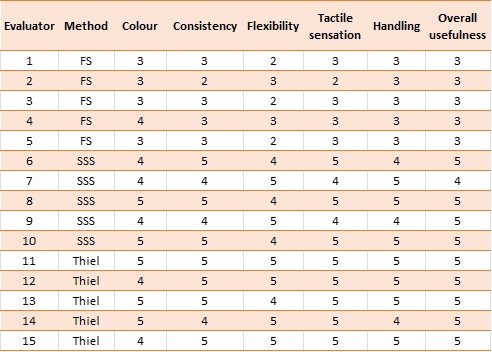
(5 evaluators assessed each embalming method. Max score : 5)
Table 3: Mean Suitability Scores by Embalming Method.
Clinician Evaluation of Surgical Skill Training Suitability
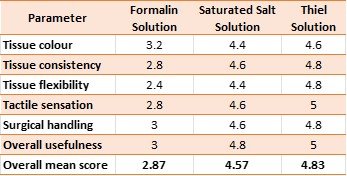
The suitability of cadavers preserved by the three embalming methods was assessed by clinicians using a five-point Likert scale. The evaluation demonstrated differences in tissue characteristics among the preservation techniques.
Formalin-preserved cadavers showed lower scores for tissue flexibility, tactile sensation and surgical handling due to increased tissue rigidity. The mean overall suitability score for formalin-preserved cadavers was 2.87/5.
Cadavers preserved using saturated salt solution demonstrated improved tissue characteristics with an overall suitability score of 4.57/5. Clinicians reported better tissue pliability, realistic tissue planes and improved handling during surgical procedures.
Thiel-preserved cadavers received the highest overall rating (4.83/5), particularly for tissue flexibility, tactile sensation and surgical realism. However, the difference between Thiel and saturated salt solution methods was minimal.
Overall, SSS embalming demonstrated comparable suitability to Thiel embalming for surgical skill training while providing advantages related to simplicity and cost-effectiveness.
Measurement of range of motion of joints in formalin and salt fixed cadaver
The range of motion (ROM) of the joints were measured on both the right and left sides of each recumbent cadaver. ROM was tested using a standard goniometer (Baseline 15 cm). In all joints, ROMs of the FS-embalmed cadaver demonstrated lower scores than those of the TS embalmed (FS vs TS). All ROMs of the SSS-embalmed cadaver tended to be better than those of the FAS embalmed, and there were significant differences in some movements (FS vs SSS in Table 4). On the contrary, there was no significant difference in ROMs between the TS and SSS-embalmed cadaver.
Table 4: Range of motion of joints in formalin, saturated salt solution and Thiel fixed cadaver.
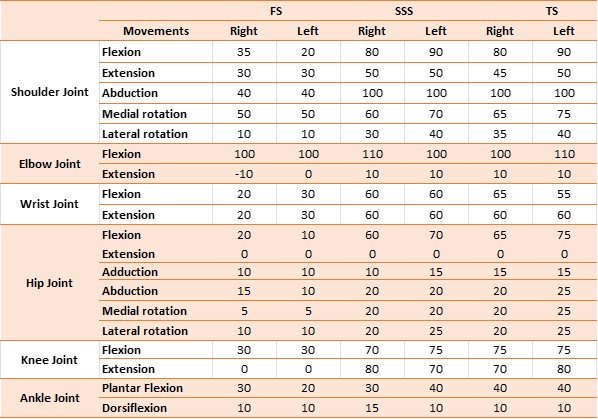
Abbreviations: FS-Formalin solution, SSS-saturated salt solution, TS-Thiel’s solution
Discussion
Cadaver-based surgical skill training has become an essential component of modern surgical education, allowing surgeons to acquire and refine technical skills in a controlled environment before performing procedures on patients. The effectiveness of cadaveric simulation depends greatly on the preservation technique employed, as embalming influences tissue texture, colour, flexibility, joint mobility and resemblance to living tissues. The present study compared formalin solution (FS), saturated salt solution (SSS) and Thiel solution (TS) embalming methods to determine their suitability for surgical skill training.
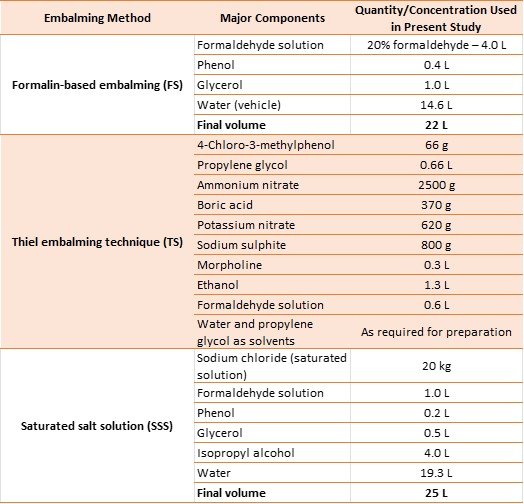
Table 5: Showing the embalming methods with components.
Formalin-based embalming has been traditionally used for anatomical preservation because of its excellent fixation properties, antimicrobial activity, low cost and long-term preservation ability. However, formaldehyde causes extensive protein cross-linking, resulting in increased tissue stiffness, reduced elasticity and decreased joint mobility. These changes limit the usefulness of formalin-fixed cadavers for procedures requiring realistic tissue manipulation and surgical simulation. Previous studies have demonstrated that formalin-fixed tissues differ considerably from living tissues due to excessive hardening and alteration of mechanical properties [3,6]. Formaldehyde reacts with proteins by forming methylene bridges, producing effective fixation but reducing tissue pliability and flexibility [3].
In the present study, formalin-preserved cadaver showed increased tissue rigidity and reduced range of motion compared with SSS- and Thiel-preserved cadavers. These findings are consistent with previous reports indicating that conventional formalin fixation produces hard tissues that are less suitable for surgical approach assessment and advanced procedural training.7 Furthermore, formaldehyde exposure has been associated with occupational health concerns, including irritation of the eyes, nose and respiratory tract among anatomy personnel and healthcare workers [6,11].
Thiel embalming has gained popularity due to its ability to maintain natural colour, tissue softness and flexibility. Thiel-preserved cadavers have been widely used for surgical training in urology, orthopaedics, minimally invasive surgery and procedural simulation because of their realistic tissue handling characteristics [4]. The present study demonstrated improved tissue quality and mobility in Thiel-embalmed cadavers compared with formalin-fixed specimens, supporting previous studies that reported superior surgical simulation characteristics with Thiel preservation [4,5].
Although Thiel embalming provides excellent tissue realism, the method has certain limitations. The preparation requires multiple chemical components, including glycol derivatives, salts, alcohols and preservatives, making it technically complex and expensive [4,6]. Additionally, gradual tissue changes, including fluid loss and altered organ consistency during prolonged storage, have been reported with Thiel-preserved cadavers [8]. These factors may restrict its routine use in institutions with limited resources.
The saturated salt solution (SSS) embalming method has emerged as a practical alternative that combines satisfactory tissue preservation with simplicity and affordability. Hayashi et al. reported that SSS-embalmed cadavers provided sufficient flexibility, low infectious risk and surgical handling characteristics comparable to Thiel-preserved cadavers during surgical skill training programmes [1]. In the present study, SSS-preserved cadavers demonstrated improved tissue softness, joint mobility and surgical handling characteristics compared with formalin-fixed cadavers.
The favourable characteristics of SSS embalming may be attributed to the combined effects of sodium chloride, low-concentration formaldehyde, phenol, glycerine and isopropyl alcohol. Sodium chloride contributes to preservation through osmotic effects and inhibition of microbial growth, whereas glycerine helps maintain tissue hydration and flexibility. Phenol and alcohol components provide antimicrobial activity and enhance preservation. Similar roles of embalming components have been described in previous reviews of cadaver preservation techniques [3,11].
The present study showed no significant difference between SSS and Thiel methods regarding tissue handling and surgical suitability. These findings correlate with the observations of Hayashi et al., who reported that surgeons evaluated SSS-preserved cadavers as comparable to Thiel cadavers during surgical skill training procedures [1]. Both methods permitted realistic performance of surgical procedures including incision, suturing, vascular procedures and ultrasound-guided interventions [1].
The usefulness of SSS embalming has also been demonstrated in reconstructive surgery training. Shirai et al. reported successful flap raising procedures using SSS-preserved cadavers, including identification and dissection of vessels and soft tissue planes similar to live surgical conditions [2]. The authors observed that vessels in SSS cadavers remained adequately expanded, facilitating identification and isolation during flap procedures [2]. These properties suggest potential applications of SSS embalming in microsurgical and reconstructive surgical training.
Microbial safety is a major consideration in cadaver-based education. Although fresh-frozen cadavers provide excellent tissue realism, they are associated with disadvantages such as limited working time, storage requirements and increased infection risk [6]. Both Thiel and SSS preservation methods provide effective microbial control while maintaining improved tissue characteristics. Hayashi et al. demonstrated adequate antibacterial and antifungal effects of the SSS method, supporting its safe use for repeated surgical training activities [1].
Histological preservation is another important factor determining embalming effectiveness. An ideal preservation technique should maintain tissue architecture while avoiding excessive fixation changes. Studies evaluating improved embalming techniques have demonstrated prolonged preservation of muscle and vascular tissues with maintenance of structural integrity [9]. The present findings suggest that SSS and Thiel methods provide superior tissue preservation compared with conventional formalin fixation.
Modern surgical education requires preservation techniques that balance tissue realism, safety, affordability and accessibility. Several reviews have highlighted the need for alternatives to traditional formalin preservation that better reproduce living tissue characteristics while reducing chemical hazards [6,11]. Although Thiel embalming provides excellent simulation quality, its complexity and cost limit widespread implementation. The SSS method offers many advantages of Thiel preservation while being simpler and economically feasible.
Therefore, based on the findings of the present study and previous literature, saturated salt solution embalming represents a valuable alternative for cadaver-based surgical training. It provides realistic tissue handling, satisfactory joint mobility, adequate microbial safety and improved affordability, making it suitable for wider adoption in anatomy departments and surgical skill training centres.
Limitations
The present study has certain limitations. The sample size was small because of the limited availability of suitable fresh cadavers. The assessment of tissue characteristics was based mainly on clinician evaluation, which may introduce subjective variation despite evaluator blinding. Quantitative biomechanical testing and microbiological assessment were not performed. Future studies with larger numbers of cadavers and objective assessment methods are required to validate these findings.
Conclusions
The present comparative pilot study demonstrates that embalming technique plays a critical role in determining the suitability of human cadavers for surgical skill training. Conventional formalin preservation, although effective for long-term anatomical preservation, resulted in increased tissue stiffness, reduced flexibility, altered tactile sensation and restricted joint mobility, limiting its application for advanced surgical simulation.
Both saturated salt solution (SSS) and Thiel embalming methods demonstrated superior tissue characteristics and functional mobility compared with formalin preservation. Clinician-based assessment showed that SSS-preserved cadavers provided realistic tissue handling, improved surgical manipulation characteristics and overall usefulness comparable to Thiel-preserved cadavers.
Although Thiel embalming achieved slightly higher scores for tissue softness and surgical realism, its requirement for multiple chemical components, prolonged preparation and higher cost may restrict its routine use. Saturated salt solution embalming offers a simpler, affordable and effective preservation technique with satisfactory tissue quality, joint mobility and microbial control.
Therefore, saturated salt solution embalming can be considered a valuable alternative preservation method for cadaver-based surgical skill training, particularly in institutions where cost-effective and easily implementable approaches are required. Further studies involving larger sample sizes, objective biomechanical analysis and long-term preservation assessment are recommended to establish its broader applicability.
Conflict of Interest: The authors declare that there are no conflicts of interest.
Funding: No external funding was received for this study.
Ethical Approval: The study was approved by the Institutional Ethics Committee of Sri Devaraj Urs Academy of Higher Education and Research . Human cadavers were obtained through the institutional body donation programme following ethical guidelines.
Cite this article: Ashwini N.S. Effectiveness of Saturated Salt Solution to Embalm Cadavers in Comparison to Thiel Solution and Formalin Solution for Surgical Skill Training. Int J Anat Res. 2026;14(3):9670–9679. DOI: 10.16965/ijar.2026.205
References
- Hayashi S, Homma H, Naito M, Oda J, Nishiyama T, Kawata S, et al. Saturated salt solution method: a useful cadaver embalming for surgical skills training. Medicine (Baltimore). 2014;93(27):e196. https://doi.org/10.1097/MD.0000000000000196 PMid:25501070 PMCid:PMC4602773
- Shirai T, Hayashi S, Itoh M, Yoshida T, Matsumoto M, Kawata S, et al. Experience of raising flaps using cadavers embalmed by saturated salt solution method. Plast Reconstr Surg Glob Open. 2015;3(3):e325. https://doi.org/10.1097/GOX.0000000000000523 PMid:26579349 PMCid:PMC4634180
- Brenner E. Human body preservation - old and new techniques. J Anat. 2014;224(3):316-344. https://doi.org/10.1111/joa.12160 PMid:24438435 PMCid:PMC3931544
- Healy SE, Rai BP, Biyani CS, et al. Thiel embalming method for cadaver preservation: a review of new training model for urologic skills training. Urology. 2015;85(3):499-504. https://doi.org/10.1016/j.urology.2014.11.009 PMid:25582818
- Balta JY, Lamb C, Soames RW. A pilot study comparing the use of Thiel- and formalin-embalmed cadavers in the teaching of human anatomy. Anat Sci Educ. 2015;8(1):86-91. https://doi.org/10.1002/ase.1470 PMid:24996059
- Hayashi S, Naito M, Kawata S, et al. History and future of human cadaver preservation for surgical training: from formalin to saturated salt solution method. Anat Sci Int. 2016;91(1):1-7. https://doi.org/10.1007/s12565-015-0299-5 PMid:26670696
- Okada R, Tsunoda A, Momiyama N, et al. Thiel's method of embalming and its usefulness in surgical assessments. Nihon Jibiinkoka Gakkai Kaiho. 2012;115(8):791-794. https://doi.org/10.3950/jibiinkoka.115.791 PMid:23016272
- Eisma R, Lamb C, Soames RW. From formalin to Thiel embalming: what changes? One anatomy department's experiences. Clin Anat. 2013;26(5):564-571. https://doi.org/10.1002/ca.22222 PMid:23408386
- Goyri-O'Neill J, Pais D, Freitas R, et al. Improvement of the embalming perfusion method: the innovation and the results by light and scanning electron microscopy. Acta Med Port. 2013;26(3):188-194.
- Valente S, Alviano F, Mazzanti B, et al. Human cadaver multipotent stromal/stem cells isolated from arteries stored in liquid nitrogen for 5 years. Stem Cell Res Ther. 2014;5(1):8. https://doi.org/10.1186/scrt397 PMid:24429026 PMCid:PMC4055119
- Balta JY, Cronin M. Human preservation techniques in anatomy: a 21st century medical education perspective. Clin Anat. 2015;28(6):725-734. https://doi.org/10.1002/ca.22585 PMid:26118424


